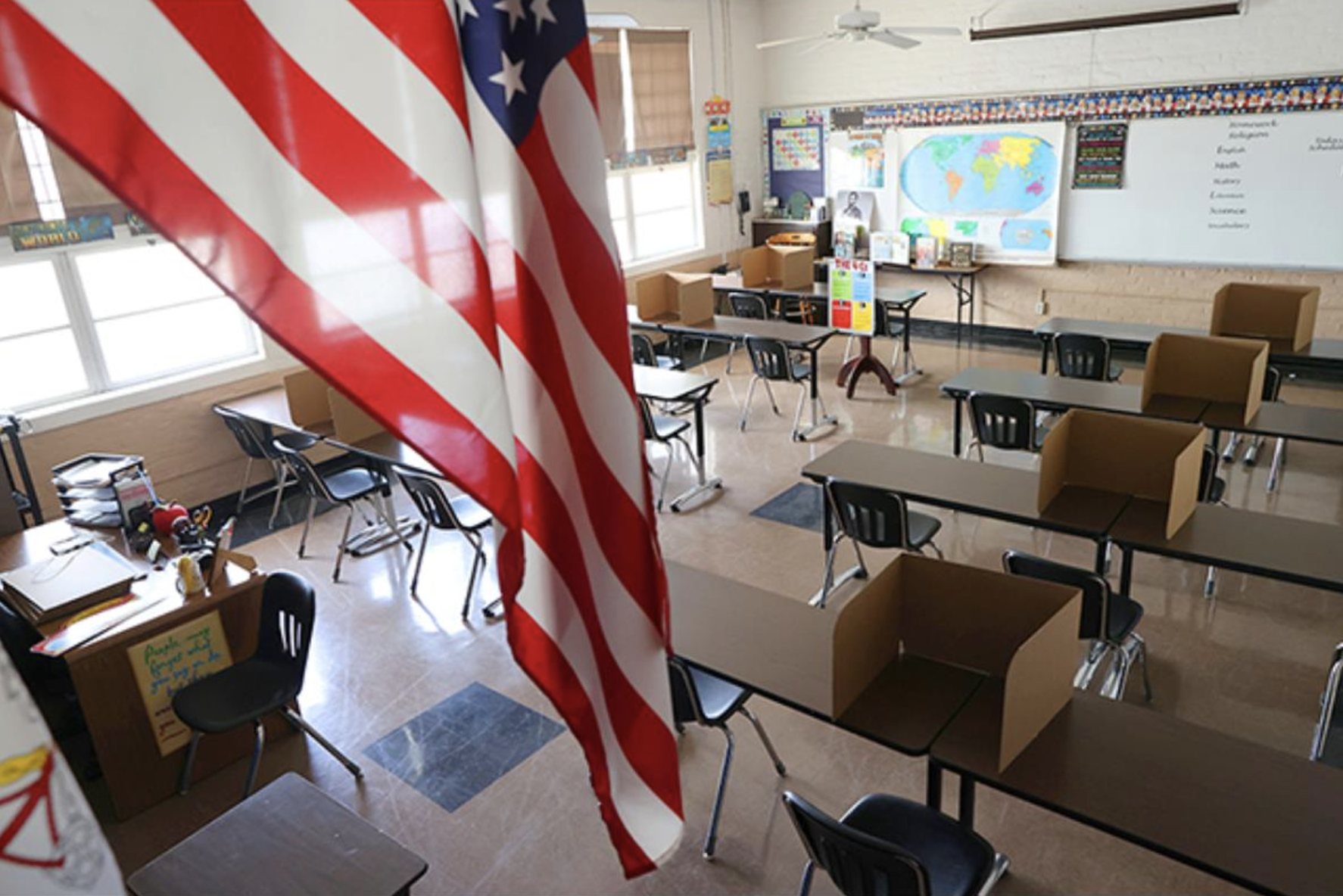

Education has been a hot area of debate in recent years due to the lockdown of 2020 due to the COVID-19 pandemic. During this time, children and parents were forced to stay home for school and work. At this time, some parents started to pay more attention to the teachings of teachers in schools, especially in Republican groups. Parents wanted to play a larger role in their children's education.
The 2024 Presidential election revealed that America is switching to a more Republican viewpoint with the re-election of former President Donald Trump. In terms of education, the main goal for the conservative party is to enforce school choice that would give power back into the hands of parents, limiting gender and race studies in schools, and limiting transgender athletes in school sports. This is a big shift in goals compared to the Democrats who wanted to give more funding to improving underprivileged schools with struggling children.
Impact of COVID
One of the biggest impacts of COVID was the switch to wide use of technology from performing homework and exams on a laptop rather than pen and paper to conducting the classroom in a Zoom meeting rather than face to face. This caused a greater divide between largely funded schools and underfunded schools. Children who did not have access to Wi-Fi or a laptop were immediately set up for failure. These children could not turn in homework or attend classes, pushing them behind their peers in subjects like math and reading. According to a Harvard study, “The average U.S. public school student in grades 3-8 lost the equivalent of a half year of learning in math and a quarter of a year in reading.”
Department of Education
The Department of Education was created in 1979 under President Carter. There were seven main purposes when the Department was first created. The first and biggest purpose is “to strengthen the Federal commitment to ensuring access to equal educational opportunity for every individual.” The main role of the Department of Education is to ensure policies made by the federal government are implemented and administer most federal aid to schools in the form of funding research and college loans. All citizens are required to attend 9-13 years of school depending on the state. Some states require children to attend school till they are 18 years old, but this depends on the state requirement. Most of the funding is funneled into higher education in the form of a federal student aid program, better known as FAFSA. Most of the funding in public K-12 schools comes through state funding and taxes.
The department also makes sure that there is equal access to education based on funding. The department handles Title I funding which aims to give funding to high poverty K-12 schools and funding for IDEA (Individuals with Disabilities Education Act) funding for children with disabilities. Historically high poverty and children with disabilities struggled to have access to schooling. These two acts help to ensure that children in America all have access to education no matter their abilities or their situations. FASFA also tries to ensure that underprivileged or struggling students have access to funding to attend higher education.
The other branch of the department focuses on civil rights. Title IX protects against discrimination based on the sex of an individual. This protects against sexual harassment and discrimination based on sex, and equal opportunities in athletics and STEM classes, and prevents discrimination based on dress code policies and enforcement of those policies. This title has been expanded recently under the Biden administration to protect transgender individuals to allow them equal access to sports and bathrooms.
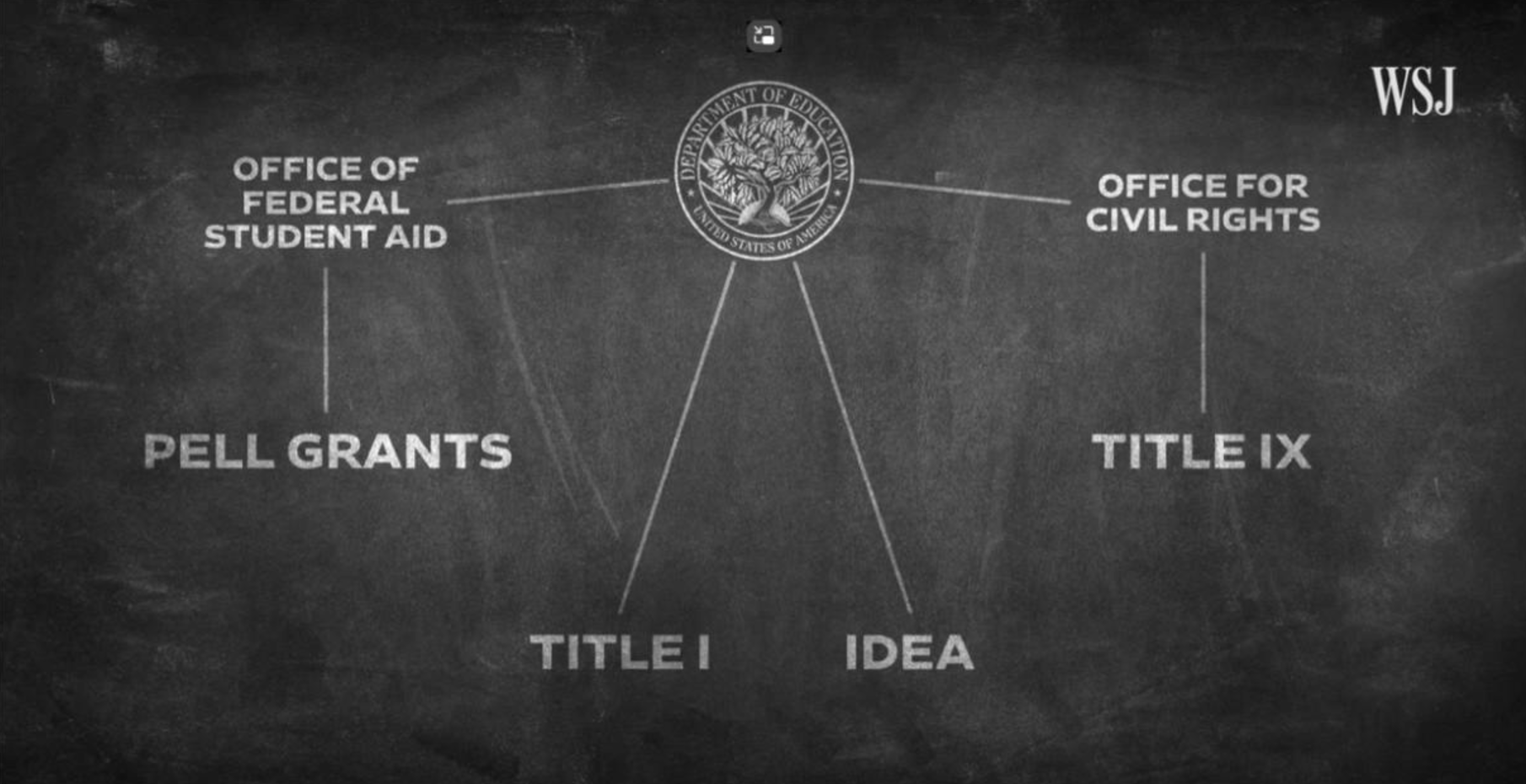
The four main jobs of the Department of Education. Ryan Trefes for the Wallstreet Journal
Most of the funding for public schools comes from the local government in the form of property taxes, not from the federal government. This means the schools that are located near middle or upper-class homes most likely have the best funding while in contrast, the schools in lower class and poverty levels struggle with funding. COVID has also led to a strain on funding for schools already causing stress on the school system.
There are some misconceptions that the Department of Education places regulations on curriculum and graduation requirements. This is untrue. The Department plays no role in establishing schools, developing curriculum, setting requirements in testing and graduation requirements, and determining education standards. The state government determines the school curriculum, individual school funding, and teacher requirements.
Future Plans of Education in K-12
With the election of Donald Trump in November, it is predicted that his front runner, Linda McMahon, is projected to be the new United States Secretary of Education. McMahon is one of the former CEOs of the WWE and a long-time friend of President Trump. She, along with Trump, aims to put school choice and curriculum choice back into the hands of parents and the state. She is following the Republican ideation to push the control of education at the State level and no longer the federal level.
In his campaign, President Trump claimed a plan to remove the Department of Education. At a rally on September 23, 2024, during his re-election campaign, he is quoted saying "One other thing I'll be doing very early in the administration is closing up the Department of Education in Washington D.C., and sending all education and education work and needs back to the states," No plan was given for what would replace the Department. In contrast, Trump also claimed to want to use the Department to control the amount of gender and race theory that is taught in schools. It is not fully understood if Trump fully intends to remove the Department completely, dismantle part of it, or use it.
Trump is not the main decider behind these ideas, and the widely feared Project 2025 is not the only think tank allegedly influencing Trump. America First Policy Institute was not even around four years ago and is now the main supporter in Trump's re-election. McMahon is even one of the leaders of this think tank that is mostly invisible to people. Through this nonprofit, millionaires donate towards the MAGA campaign with McMahon reportedly donating $20 million alone. What are AFPI's goals for education?
The biggest policy goal is school choice and on the other hand more parental choice. AFPI wants to limit federal influence and keep it in the hands of the state or at a local level. This would mean reducing school funding and redirecting funding and resources into school choice for the best needs of the children. Republicans are pushing for the government to pay for funding for children to go to private schools if that is what the parent wants. Parents want to play a larger role in what their children are being taught, and what is allowed and not allowed. Many of these parents are pushing to limit or remove the teaching of gender and race theory and some even pushing to teach the Bible and prayer in schools.
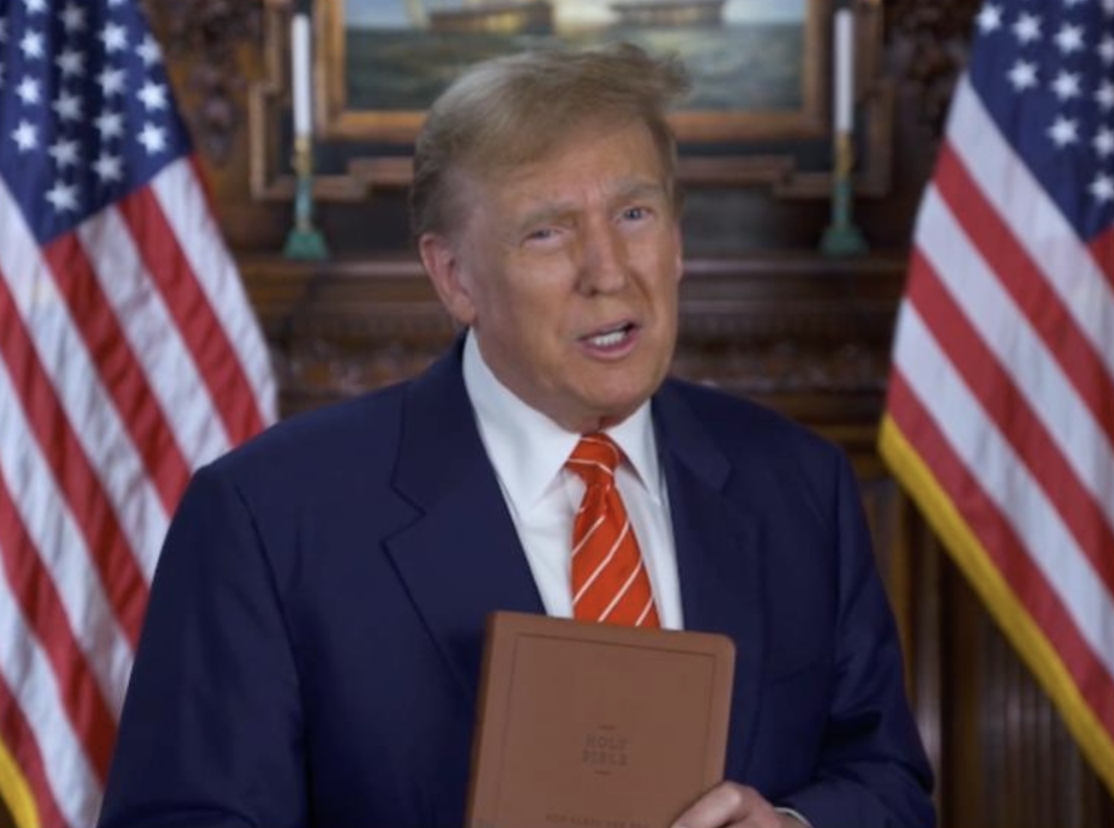
Trump’s ‘God Bless the USA’ Bibles are selling for $59.99 with the slogan “Make America prey again”
Republicans want to control the dialogue of what is being taught in school. They want to have their children be influenced by what they think is best and leave out what they think their children should not be taught. Ryan Walters, a state superintendent of Public Instruction in Oklahoma, is pushing for the elimination of the Department and mandating prayer in schools. He bought Bibles that are sponsored by Trump that contain the text of the Bible, the Constitution, the Declaration of Independence, and the Bill of Rights and aims to use them in AP Government classes. Walters used taxpayer money to buy these Bibles, and all the funds went into Trump's pockets. When instead this money could be used to help improve test scores.
Outlook on the Future of Education
By eliminating funding for underprivileged schools, schoolteachers and workers are at risk of being laid off, and after school programs could be canceled due to lack of funding. Without enriching activities and teachers, students will fall further behind and risk not graduating or having skills for jobs. Schools are more than just a place to learn history, they are a place where children learn how to interact in a social environment and learn problem solving skills to use outside of school. After school activities help to enrich children and create well rounded students that obtain skills outside of education and can even give some students scholarship opportunities.
Supporters of the Department of Education fear for the future of students. In an interview with Sarah Abernathy , an executive director of the Committee for Education Funding, a group that advocates for K-12 education, points out, “You’re talking about not only affecting kids’ education but also the economy of these communities. I don’t think that’s something that people have factored into what they may consider an easy catchphrase of eliminating the Department of Education or dramatically cutting education funding.” The lives of students are not the only ones affected; the livelihood of school workers will also be affected by budget cuts.
Parents deserve to play a role in the education of their children, there is no doubt about that. However, how much should parents be involved? Most parents do not have the requirements to know fully what should and should not be taught, teachers and administrators have those requirements. By leaving out important topics, students are missing out on a wide range of information that could be crucial in the future. Gender and race theory are sensitive topics, but they are topics that should be discussed. These are real issues that are still prevalent in society. By not teaching these topics, the issue is just being pushed under the rug and not being given the recognition that it needed. The people who are affected by the ignored issues are going to continue to suffer if their stories are not told and understood.
Expressing religion in schools is a paradox. It is at first exercising the First Amendment of freedom of religion, however it is also violating it by not allowing all religions to be exercised, including not practicing religion. America is moving towards the narrowing of the separation of church and state, which should always be separated, and the separation has been encouraged since the birth of this country. If religion is to be expressed in schools, all religions should be taught at the same time and should not be mandated if it is being taught. If freedom of choice wants to be respected, then it has to go both ways. Being one sided and limiting choice is not freedom of choice.
The future of education in America is not set in stone currently. There is still one more month till Trump is set to take over as president. His plans are not fully understood currently. No solid plan has been announced for what the future of the Department of Education looks like, whether it remains or will be dismantled. Only time will tell what the future will look like for the young generations of Americans.